
Dolores Weekly Arrest Log Sources
Dolores County posts no multi-day booking list. The Dolores County Sheriff page offers law-enforcement contacts and a description of 24-hour dispatch, but no rolling 72-hour or weekly roster. Nor does any neighboring office fill the gap. The Montezuma County Detention Division explains its regional booking, bonding, and transport duties, though it publishes no Dolores-filtered arrest log. Your search becomes a source-by-source job. The Journal's sheriff blotter carries the strongest public narrative. It bundles incidents from several dates and sometimes covers Dolores-area events or transport to Montezuma Detention Center. That format helps once an event has reached local reporting. It is not comprehensive. Editorial selection, article timing, and thin fields keep it from serving as a county booking database.
Read Dolores Arrest Blotters Carefully
Work backward from the story to the source record. A narrative entry may name the incident, the response, a charge, or a transport destination while saying nothing about a booking number, bond, release, or final court result. Notice the difference. Precision about what the article actually states saves you from reading facts into it.
- Record the article's publication date and the separate date assigned to each incident.
- Identify the named agency, location, and any stated transport or detention destination.
- Check whether the text reports an arrest, a citation, a call for service, or only an investigation.
- Verify the booking with the likely detention custodian and request the underlying report when needed.
- Use the Dolores court docket or court documents for later hearings and the disposition.
Something that may have happened today calls for the Daily Arrest Report process instead of waiting on a news article. That path starts with direct agency and detention confirmation. The blotter plays a different role. It collects selected incidents across several dates and hands you leads for older records.
Dolores Arrest Log Fields
These blotters run in prose, not rows and columns. Fields shift from entry to entry, so treat the inventory below as a reading aid rather than a promise of what each item will contain.
| Possible item | How to interpret it |
|---|---|
| Incident date | The date assigned to the reported event, which may precede publication. |
| Place | A city, road, address, or general Dolores-area location. |
| Agency action | A response, investigation, citation, arrest, or transport described in narrative form. |
| Alleged offense | An charge reported at that stage. |
| Custody destination | A stated transport to Montezuma Detention Center or another facility, when included. |
| Image | Publisher material, if any. It is not automatically an official booking photograph. |
An official booking file holds different facts. Expect an entrance date, charges listed by code and jurisdiction, a bond amount, and a release date. It may also carry a booking number, the arresting agency, transfer details, or a photo. None of that appears on Dolores County's web columns. Ask the responsible records office for the exact document.
Dolores Weekend Arrest Posting
No official schedule governs weekend or holiday posting. The Dolores Sheriff runs dispatch around the clock, so arrests can happen at any hour. News follows an editorial calendar of its own. Records offices keep separate hours. None of that adds up to a weekly log refreshing at a fixed time. A weekend arrest may be booked regionally long before a blotter mentions it. It may never make the news at all. A weekday article, meanwhile, can gather incidents from several earlier dates. Compare the event date against the publication date. Then confirm the custody or case record with the right office. The Dolores County arrest-record hub untangles those roles. It maps the Dolores County Sheriff, Montezuma detention, and the Dolores Combined Court, which helps when a story names one county while detention took place in the other.
Note: Twenty-four-hour dispatch describes agency availability, not a promise that arrest records or news entries post around the clock.
Dolores Multi-Date Arrest Coverage
The multi-date sheriff blotter from The Journal demonstrates the narrative format at work. It also separates incident dates from the publication date.
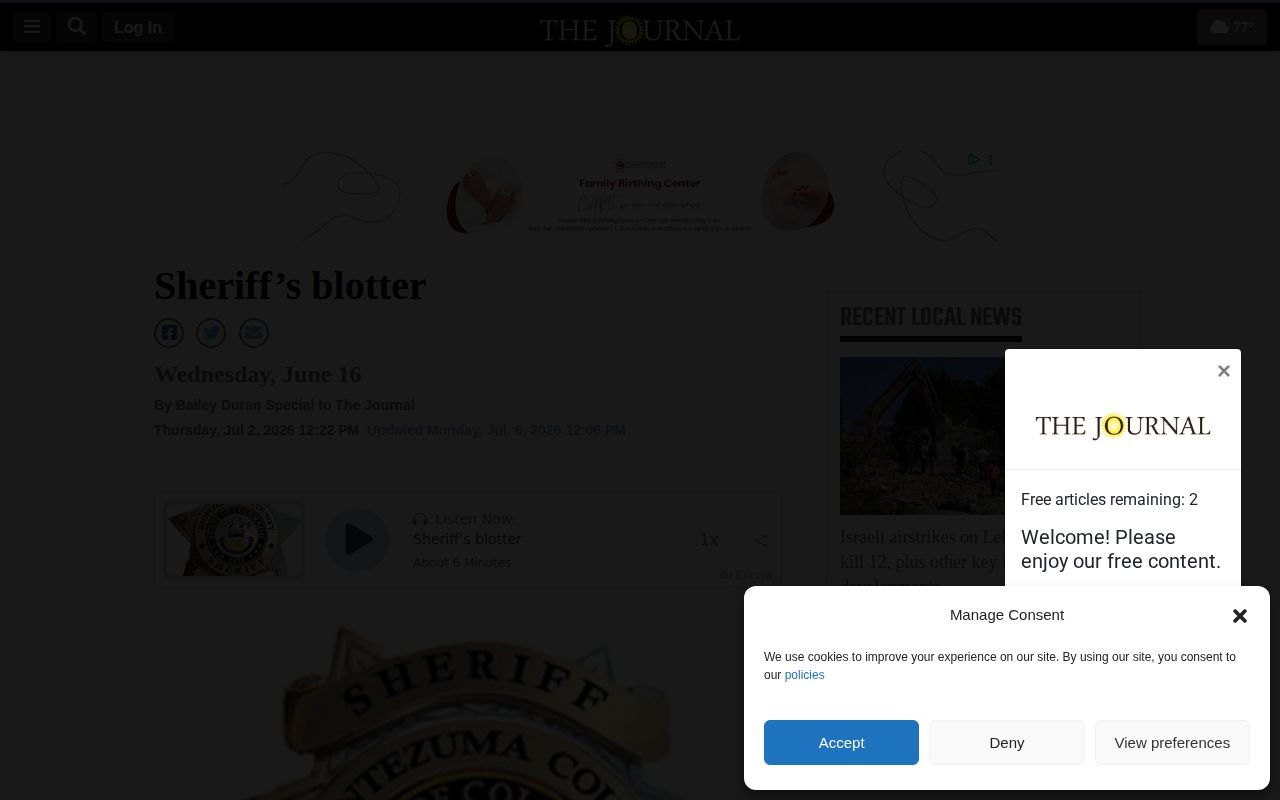
This is regional journalism, not an official roster. Treat a named entry as a lead only. Verify it with the Sheriff, the detention office, or the court. The Journal's lineage includes the former Dolores Star, which is why it turns up in county searches. Even so, an editor decides what runs. Names may be withheld, a citation dropped, and later court outcomes never added to the story.
Older Dolores Arrest Blotter Format
An older Journal sheriff blotter repeats the multi-date format. It proves a pattern, though not a fixed weekly cadence or a complete archive.
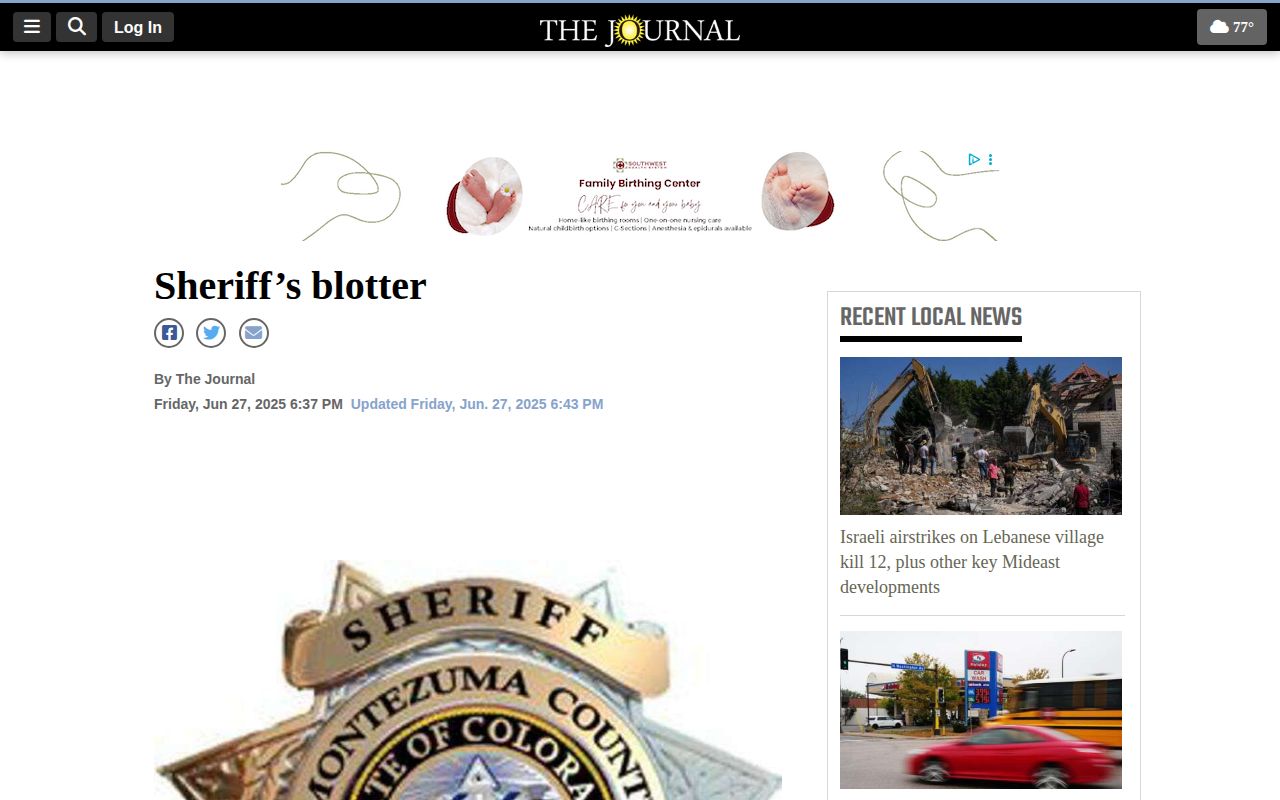
That older blotter helps you spot a publication pattern. It cannot prove every Dolores County arrest from that stretch made the page. Regional reporting also mixes places. The Town of Dolores sits in Montezuma County, not this one. Dove Creek and Rico are the county's incorporated towns. Read the location line before you assign an entry, since the shared name alone proves nothing.
Dolores Arrest Counts Need Context
Arrest numbers for Dolores County are easy to overstate. Montezuma publishes monthly detention statistics. The Journal prints selected incidents. Each source counts something different. The two cannot be merged into one master arrest trend for the county. One tracks people processed or held in regional facility categories. The other reflects whatever an editor chose to cover that week. Neither offers a true arrest count. A denominator and a steady scope are missing from both. Historical rows need their date labels too. One monthly report placed five people in a Dolores County category. A later report showed a different snapshot. Those figures describe only the periods and categories they cover. They are not a live jail count or a weekly arrest total. An omitted month proves nothing about arrests that month. Use the data to understand the regional relationship, not to identify a person. A name search belongs with the arresting agency, the booking custodian, or the court file.
Dolores Arrest Archives and Retention
The Journal keeps older articles online, but the archive has no guaranteed rolloff. Nothing promises a seven-day window. Nothing promises a full index either. An article can outlive the record behind it. Its presence says nothing about who is in custody now. Dolores County publishes no booking-record retention schedule of its own. A statewide sheriff template lists example periods. Yet it stays optional until a local office adopts it. So ask the Dolores Sheriff directly. Which approved schedule governs the arrest report? For a regional booking, ask Montezuma records. Do they still hold the file, or was it transferred? Keep a request focused. Give the person's name, an approximate date, the arresting agency, and the record you want. A booking report, a release or transfer entry, and any releasable photo cover most needs. If the case reached court, request the register of action from Dolores Combined Court. Court retention runs on its own rules. Some files are juvenile, sealed, or tied to an open case. Others were destroyed or moved under an approved schedule. When a record is missing, ask questions. What schedule title and version apply? Which transfer or destruction authority is behind it?
Note: A retained arrest article is historical reporting, not proof of guilt, current custody, or an unchanged charge.
Verify Dolores Arrest Outcomes
Colorado's judicial docket lists scheduled proceedings in Dolores County. Bond hearings, first appearances, arraignments, pleas, and sentencing events all appear there. A docket entry is not the final outcome. With the case number and party details, request the register of action or an outcome document when it is public.
Court records can also be restricted. Juvenile, sealed, or suppressed matters stay out of public search results. An empty result is not a statement about the event. The office holding the record decides access. Current law and any order in effect control the rest.